Using UAE Documents Abroad? How to Know Which Authentication Route You Need

If you have a document issued in the UAE and need to use it in another country, one of the first things you may wonder is:
“What do I need to do to make this document acceptable abroad?”
There isn’t one standard process for every document.
The right route depends on several factors, including the type of document, where it was issued, the country where you plan to use it, and the reason you need it.
Depending on the destination country's requirements, you may need document authentication, MOFA attestation, embassy or consular legalization, an apostille, certified translation, or a combination of these.
In this guide, we'll break it down step by step so you can better understand how to authenticate UAE documents for overseas use and what to check before you begin.
Understanding Document Authentication for Use Abroad
Document authentication for use abroad is the process of verifying a document issued in one country so that it can be recognized by authorities in another country.
For example, you may need to use a UAE-issued:
Birth Certificate
Marriage Certificate
Educational Certificate
Police Clearance Certificate
Degree or Diploma
Commercial Document
Power of Attorney
Other official government document
If you're submitting one of these documents to a foreign government authority, university, employer, immigration office, court, or another organization, additional authentication or legalization may be required.
The exact requirements depend largely on the destination country and what the document will be used for.
Why Do UAE Documents Need Authentication for Overseas Use?
A document that is valid and officially issued in the UAE may not automatically be accepted by an authority in another country.
The receiving authority may need to confirm that:
The document is genuine.
The signature or seal is authentic.
The document was issued by an authorized UAE authority.
Any required authentication steps have been completed.
The document is suitable for its intended purpose in the destination country.
This is why a document that is perfectly valid for use inside the UAE may still need additional authentication before it can be used overseas.
How to Know Which Authentication Route You Need
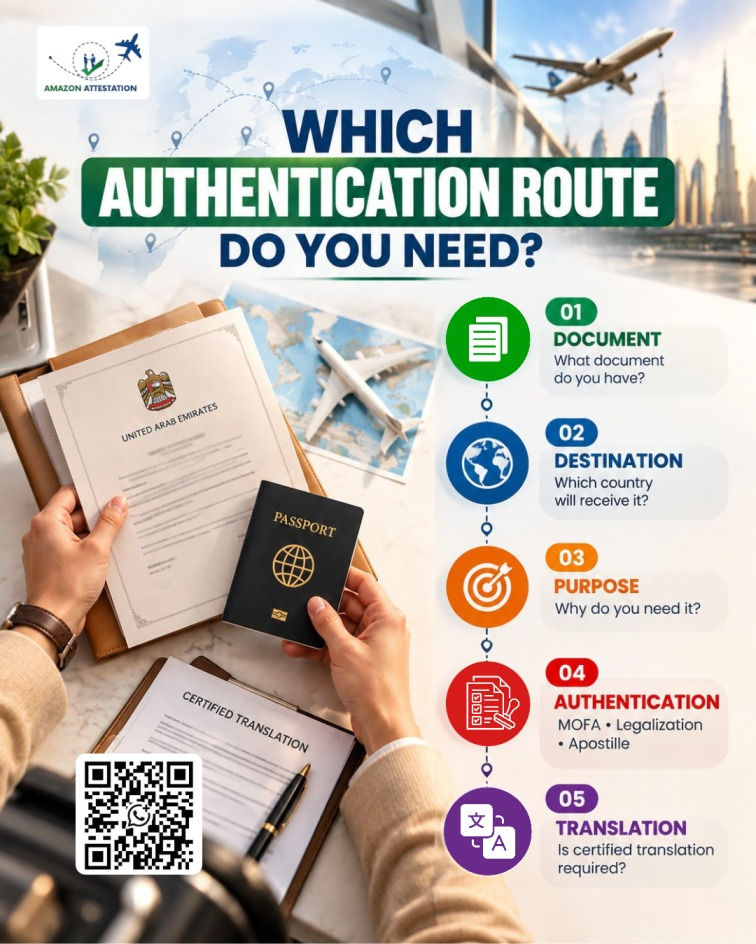
A simple way to understand the process is to start with these five points:
Document → Destination Country → Purpose → Authentication → Translation
Let's look at each one.
1. Start With the Document You Have
First, identify exactly what type of document you want to use abroad.
Different types of documents can have different authentication requirements.
Personal Documents
These may include:
Birth Certificates
Marriage Certificates
Divorce Certificates
Death Certificates
Police Clearance Certificates
Other civil-status documents
Educational Documents
These may include:
Degree Certificates
Diploma Certificates
School Certificates
Transcripts
Educational Statements
Educational documents may sometimes require additional verification or authentication before the main legalization process.
Commercial Documents
Businesses may need to authenticate documents such as:
Trade-related documents
Commercial agreements
Invoices
Certificates
Powers of Attorney
Company documents
The requirements can also depend on where the document will be submitted—for example, a government authority, company, court, bank, or another organization.
The important thing is not to assume that every UAE document follows the same route.
2. Check the Destination Country
The next question is simple:
Which country will receive the document?
This is one of the most important things to establish before starting the process.
A UAE-issued document may require a different authentication route depending on the country where you plan to use it.
Depending on the destination, you may need:
UAE government authentication
MOFA document attestation
Embassy or Consulate legalization
Apostille, where applicable
Certified translation
Additional verification by the receiving authority
Some countries have specific procedures for documents issued overseas, while others may have different requirements depending on the type of document.
Why Does the Destination Matter?
Imagine two people have the same type of UAE-issued certificate.
One needs to use it in Country A, while the other needs it in Country B.
Even though they have the same type of document, their authentication requirements may be different because each destination country can have its own document-recognition procedures.
That's why it's a good idea to check the destination country before starting the process. It can help you avoid unnecessary steps, costs, and delays.
3. Consider Why You Need the Document
The purpose of the document can also affect the process.
Ask yourself:
“What am I going to use this document for?”
Common reasons include:
Employment
An employer or government authority may request authenticated educational or professional documents.
Education
A university, college, or educational authority may ask for authenticated certificates and transcripts.
Immigration
Immigration or visa authorities may require authenticated personal or educational documents.
Marriage or Family Matters
Marriage and birth certificates may need authentication when they are being submitted for family, residency, marriage, or other legal procedures overseas.
Business
Companies may need authenticated commercial documents, agreements, certificates, or powers of attorney when dealing with organizations in another country.
Legal Purposes
Courts, lawyers, government departments, and other legal authorities may have their own document requirements.
So, even when the document itself is the same, the practical requirements can change depending on where and why it will be submitted.
4. Understand Authentication, Attestation and Legalization
You may come across terms such as authentication, attestation, legalization, and apostille while researching the process.
These terms can refer to different stages or systems depending on the countries involved.
What Is Document Authentication for Use Abroad?
Authentication generally means confirming the authenticity of a document, signature, seal, or issuing authority so that the document can be recognized outside the country where it was issued.
What Is MOFA Attestation?
For documents issued or processed in the UAE, MOFA attestation may be one of the required steps for international document use.
The Ministry of Foreign Affairs authentication process helps verify documents according to the applicable UAE procedures.
However, MOFA attestation does not necessarily mean that a foreign authority will accept the document without any additional requirements.
The destination country's rules should still be checked.
What Is Embassy or Consular Legalization?
Depending on the destination country and the applicable procedure, the document may also need to be submitted to the relevant embassy or consulate.
This is commonly known as embassy legalization or consular legalization.
What Is an Apostille?
For countries covered by the Hague Apostille system, an apostille may be the applicable form of authentication instead of traditional legalization.
Whether an apostille applies depends on the countries involved and the type of document.
So, don't automatically assume that MOFA attestation or an apostille is the correct route for every document you plan to use abroad.
5. Check Whether Translation Is Required
Authentication is only one part of preparing a document for overseas use.
The receiving authority may also require your document to be translated into a specific language.
For example, you may be asked for:
Arabic translation
English translation
French translation
German translation
Another locally accepted language
In some cases, the translation itself may need to be completed by a certified or legally recognized translator.
Don't Leave Translation Until the Last Minute
Before submitting your document, check whether the receiving authority requires:
The original document
An authenticated document
A certified translation
Authentication or certification of the translation
The required order can vary, so it's important to follow the instructions provided by the authority receiving your document.
A Simple UAE Document Authentication Flow
While the exact requirements vary depending on the document and destination country, you can think of the process in the following order:
Step 1: Identify the Document
Determine whether you have an educational, personal, commercial, legal, or other official document.
Step 2: Identify the Destination Country
Find out exactly where the document will be submitted.
Step 3: Confirm the Purpose
Is the document for employment, education, immigration, marriage, business, legal use, or another purpose?
Step 4: Check the Authentication Route
Find out whether you need document authentication, MOFA attestation, embassy or consular legalization, an apostille, or another form of verification.
Step 5: Complete Any Preliminary Authentication
Some documents may require verification or authentication by the relevant issuing authority before moving on to later stages.
Step 6: Complete UAE-Side Authentication
Depending on the applicable route, this may include MOFA attestation or another authentication procedure.
Step 7: Check Embassy or Consular Requirements
If the destination country's authorities require embassy or consular legalization, complete the applicable step.
Step 8: Arrange Certified Translation
If the receiving authority requires another language or a legally recognized translation, arrange it according to their requirements.
Step 9: Confirm the Final Requirements
Before sending or submitting the document abroad, confirm with the receiving authority that your completed document meets its current requirements.
Example: Using a UAE Marriage Certificate Abroad
Let's say you have a marriage certificate issued in the UAE and need to submit it to an authority in another country.
Instead of asking only:
“Where can I get MOFA attestation?”
it may be more useful to ask:
“What authentication does this UAE marriage certificate need for use in my destination country?”
Before starting, check:
Where the marriage certificate was issued
Which authority issued it
Which country will receive it
Why you are submitting it
Whether authentication is required
Whether embassy or consular legalization is required
Whether a translation is required
Whether the receiving authority has any additional requirements
Taking these points into account can help you identify the appropriate route before spending time and money on steps that may not be necessary.
What About UAE Educational Documents?
Educational documents can come with additional requirements.
If you have a UAE-issued degree, diploma, transcript, or school certificate and plan to use it overseas, the receiving university, employer, immigration authority, or professional organization may request verification or authentication before accepting it.
Before processing an educational document, check:
Which certificate is required
Whether transcripts are also required
Whether verification is required
The destination country's authentication procedure
Whether embassy or consular legalization applies
Whether translation is required
If you're unsure, it's better to confirm the requirements before beginning the process.
UAE Document Authentication Checklist
Before you begin, use this quick checklist.
Document
☐ What type of document is it?
☐ Where was it issued?
☐ Is it an original or certified copy?
Destination
☐ Which country will receive it?
☐ Which organization or authority will receive it?
Purpose
☐ Employment?
☐ Education?
☐ Immigration?
☐ Family or marriage?
☐ Business?
☐ Legal use?
Authentication
☐ Is authentication required?
☐ Is MOFA attestation required?
☐ Is embassy or consular legalization required?
☐ Does an apostille apply?
☐ Is additional verification required?
Translation
☐ Is translation required?
☐ Which language is required?
☐ Does the translation need to be certified or legally recognized?
Checking these points before you start can make the entire document process much clearer.
Need Help With UAE Document Authentication for Overseas Use?
If you're planning to use a UAE-issued document in another country, the first step is understanding which route applies to your particular document and destination.
At Amazon Attestation and Businessmen Services Center, we assist with document-related procedures including MOFA Attestation, Embassy & Consulate Attestation, Certified Legal Translation, and Document Clearing Services.
Whether you have a personal document, educational certificate, commercial document, or another official document, our team can help you understand the applicable process before you proceed.
Not sure which route your document needs?
Send us the document type, issuing country, and destination country for assistance before processing.
This can help you understand the authentication and legalization requirements that may apply to your intended use. Ajman: +971 6740 3110
WhatsApp: +971 54 582 0983
Email: info@amazonattestation.com
Final Takeaway
When you need to use a UAE document abroad, don't start by choosing an attestation service before understanding what your destination actually requires.
Start with the document, identify the destination country, confirm the purpose, and then check the appropriate authentication, legalization, and translation requirements.
The correct route can vary from one document and destination to another.
If you're unsure what your document needs, checking the requirements before you begin can help you avoid unnecessary steps and delays.
Need assistance? Send us your document type, issuing country, and destination country, and our team can help you understand the appropriate document authentication route.


Comments