Power of Attorney Attestation in the UAE: What to Check Before Signing

If you are preparing a Power of Attorney (POA) for use in the UAE or abroad, it is worth checking the document carefully before you sign it.
A Power of Attorney gives another person the authority to act on your behalf. Depending on where the document will be used, it may need to be notarized, translated, authenticated, legalized, or attested before it can be accepted by the relevant authority.
One common mistake is to sign the POA first and only ask about attestation afterward. By that point, the document may need to be amended, re-signed, or prepared again.
Understanding the requirements before signing can help avoid unnecessary delays.
What Is a Power of Attorney?
A Power of Attorney is a legal document that allows one person to authorize another person to act on their behalf.
The person giving the authority is commonly referred to as the principal or grantor, while the person receiving the authority is the agent or attorney-in-fact.
A POA may be prepared for different purposes, such as:
Managing property or real estate matters
Handling business or company-related transactions
Representing someone before an authority
Managing financial or banking matters
Completing administrative procedures
Handling legal or personal matters
Representing someone in another country
The exact powers granted should be clearly stated in the document.
Why Check the POA Before Signing?
The attestation process depends on more than the document itself.
The country where the POA was issued, the country where it will be used, the purpose of the document, and the receiving authority can all affect what steps are required.
For this reason, it is better to determine the expected authentication route before signing the final document.
A POA prepared for use in another country may require a different process from a POA intended for use within the UAE.
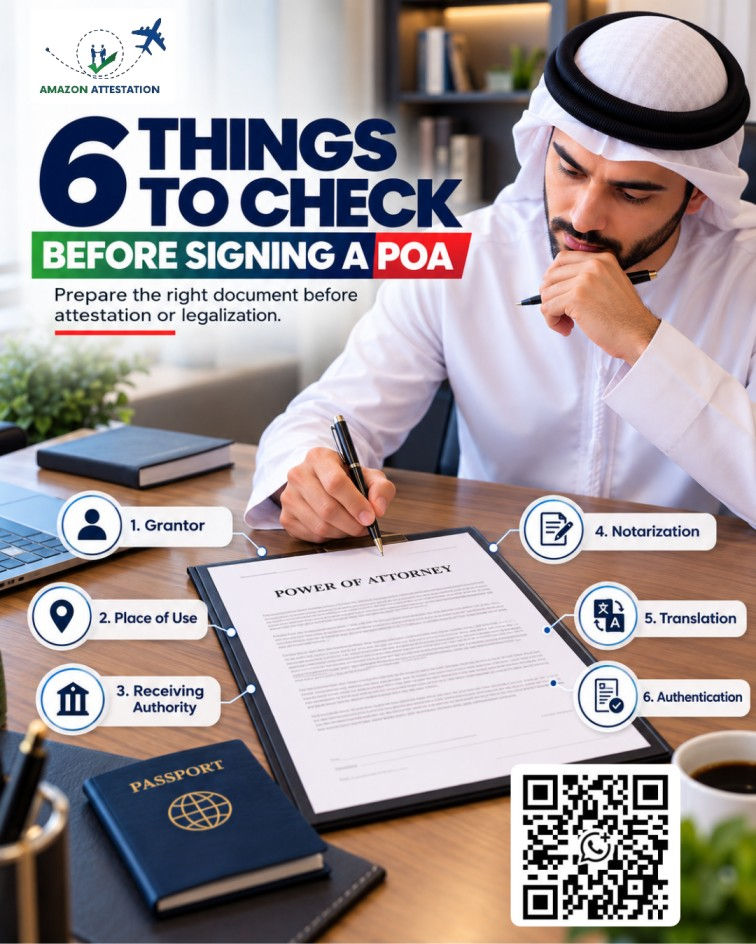
6 Things to Check Before Signing a Power of Attorney
1. Who Is Granting the Power of Attorney?
Start by checking the identity and details of the person granting the POA.
Make sure the name, identification details, nationality or other required information are accurate and consistent with the supporting documents.
Even a small difference in spelling or personal details can create problems when the document is submitted to another authority.
Before signing, check:
Full name
Passport or Emirates ID details, where applicable
Address or other required personal information
Date of birth or other identifying information, if required
Supporting documents
If the POA is being prepared on behalf of a company, additional company information and authorization requirements may apply.
2. Where Will the POA Be Used?
This is one of the most important questions to answer before signing.
A Power of Attorney intended for use in the UAE may follow a different process from a POA that will be used in another country.
For overseas use, the destination country may have specific requirements relating to:
Notarization
Authentication
Embassy or Consulate legalization
MOFA attestation
Certified translation
Additional verification
The receiving authority may also have its own document requirements.
If you know the destination country and intended use before preparing the POA, it is easier to identify the appropriate route.
3. Who Will Receive or Use the POA?
Knowing who will receive the document is just as important as knowing where it will be used.
For example, the POA may need to be submitted to:
A government authority
A court
A bank
A property-related authority
A company or business
An embassy or consulate
A legal representative
Another organization overseas
Ask the receiving organization what form of POA they accept before finalizing the document.
Their requirements may determine whether notarization, legalization, translation, or further attestation is needed.
4. Does the POA Need to Be Notarized?
Depending on the circumstances, a POA may need to be notarized before further authentication or attestation.
Notarization and attestation are not necessarily the same thing.
Notarization generally involves a notary confirming the execution or authenticity of a document or signature according to the applicable legal process.
Attestation or legalization, on the other hand, involves authentication steps used to establish the document's validity for acceptance by another authority or country.
The exact procedure depends on the document and its intended use.
If notarization is required, it is important to complete the appropriate step before moving on to later authentication or attestation stages.
For assistance with notarization requirements, you can also explore our [Notary Public Services].
5. Is Translation Required?
Language can become an important part of the authentication process.
If the POA is written in one language but will be submitted to an authority that requires another language, a certified legal translation may be required.
For example, an authority may request an Arabic or English version of the document, depending on the circumstances.
Before arranging translation, check:
Which language the receiving authority accepts
Whether certified translation is required
Whether the translation must be completed by an approved legal translator
Whether the translated document also needs authentication or attestation
Using the correct translation process from the beginning can help prevent the need to repeat the procedure later.
For language-related requirements, see our [Certified Legal Translation Services].
6. Is Further Authentication or Attestation Required?
Signing and notarizing a POA does not necessarily mean the document is ready for its final use.
Depending on the situation, additional authentication may be required.
Possible steps can include:
Notarization → Authentication → Embassy/Consulate Legalization → MOFA Attestation → Certified Translation
However, this is only an example. The actual route can vary depending on the country of issue, destination country, document type, and intended use.
For UAE-related requirements, MOFA Attestation may be part of the process where applicable.
You can learn more about the general process through our [MOFA Attestation Services].
For documents intended for use through a foreign embassy or consulate, [Embassy Attestation Services] may also be relevant.
Power of Attorney Attestation for Overseas Use
If you are preparing a POA for use outside the country where it was issued, do not assume that one authentication step will be enough.
The destination country may require a specific legalization route before the document can be accepted.
For example, the process may involve authentication in the country where the POA was issued, followed by embassy or consulate legalization and further attestation in the destination country.
The exact requirements can vary, so the intended country of use should be identified before the document is finalized.
What Documents May Be Needed?
The supporting documents required for power of attorney attestation in the UAE can vary according to the circumstances.
Depending on the case, you may be asked to provide:
Original Power of Attorney
Passport copy
Emirates ID copy, where applicable
Identification documents of the authorized person
Supporting legal or commercial documents
Company documents, for corporate POAs
Notarization documents
Certified translation, where required
Previous authentication or legalization documents
Always check the requirements applicable to your particular POA before submitting the document.
Common Mistakes to Avoid
A few simple mistakes can make the process more complicated.
Signing Before Checking the Requirements
This is one of the most avoidable problems.
If the receiving authority requires specific wording, formatting, notarization, or translation, you may need to prepare and sign the document again.
Using the Wrong Authentication Route
Not every POA follows the same attestation process.
The correct route depends on where the document was issued and where it will be used.
Ignoring Translation Requirements
A document may be legally prepared but still not be accepted if the receiving authority requires a specific language or certified translation.
Checking Only the Attestation Requirement
Attestation is only one part of the overall process.
The receiving authority may also have requirements concerning the wording, validity period, identification documents, signatures, or supporting paperwork.
Assuming Requirements Are the Same Everywhere
A POA accepted by one authority or country may not automatically meet the requirements of another.
Always confirm the requirements of the organization that will actually receive the document.
Power of Attorney Attestation in the UAE: A Simple Checklist
Before signing your POA, ask these questions:
Who is granting the Power of Attorney?
Who is being authorized?
What specific powers are being granted?
Where will the POA be used?
Who will receive the document?
Does it need to be notarized?
Is a certified translation required?
Does it require embassy or consulate legalization?
Is MOFA attestation required?
Are additional supporting documents needed?
Does the receiving authority have a specific format or wording requirement?
If you can answer these questions before signing, you are in a much better position to prepare the document correctly.
When Should You Start the Attestation Process?
Ideally, check the authentication and attestation requirements before the final POA is signed.
This is especially important when the document will be used internationally.
Starting with the destination authority's requirements can help you understand whether the POA needs:
Specific wording
Notarization
Authentication
Embassy or Consulate legalization
Certified translation
MOFA attestation
Additional supporting documents
Once the requirements are clear, you can prepare the document accordingly rather than correcting it after signing.
Need Help With Power of Attorney Attestation?
Preparing a POA for official use can involve several steps, particularly when the document is intended for use overseas.
At Amazon Attestation, we assist with document attestation and legalization requirements, including support for Power of Attorney documents, MOFA attestation, embassy legalization, and certified legal translation.
If you are unsure which steps your POA requires, it is better to check before signing or submitting the document.
Preparing a Power of Attorney for official use?
Get the document checked before signing or submitting it for attestation.
Call: +971 6740 3110 WhatsApp: +971 54 582 0983 Email: info@amazonattestation.com
Frequently Asked Questions
What is Power of Attorney attestation in the UAE?
Power of Attorney attestation refers to the authentication or legalization steps required to establish a POA's validity for use with the relevant UAE or foreign authority. The exact process depends on where the document was issued and where it will be used.
Does a Power of Attorney need to be notarized before attestation?
It may need to be notarized, depending on the document and its intended use. Notarization requirements should be confirmed before signing and starting the attestation process.
Can a UAE Power of Attorney be used abroad?
A UAE-issued POA may be used abroad if it meets the requirements of the destination country and receiving authority. Additional authentication, embassy or consulate legalization, translation, or other steps may be required.
Is MOFA attestation required for a Power of Attorney?
MOFA attestation may be required in certain situations, but it is not automatically the same for every POA. The required process depends on the document's origin, destination, and intended use.
Does a Power of Attorney need translation?
A translation may be required when the receiving authority does not accept the original language. In some cases, a certified or legal translation may be required.
Can I attest a Power of Attorney after signing it?
In many cases, the signed document can proceed through the required authentication process. However, it is safer to check the requirements before signing because the receiving authority may require specific wording, notarization, formatting, or supporting documents.
How long does Power of Attorney attestation take in the UAE?
Processing time can vary depending on the type of POA, country of issue, destination country, required authentication steps, and the relevant authorities. Confirming the requirements in advance can help avoid unnecessary delays.
What documents are needed for POA attestation?
Requirements vary, but may include the original POA, identification documents, notarization records, company documents for corporate POAs, certified translations, and previous authentication documents where applicable.
Final Thoughts
A Power of Attorney is more than just a document that needs a signature.
If it will be used for an important legal, business, property, financial, or international matter, the requirements should be checked before signing.
Knowing the destination, receiving authority, notarization requirements, translation needs, and possible authentication route can help you avoid having to redo the document later.
Check first.
Sign correctly.
Then proceed with the appropriate attestation or legalization process.


Comments