Power of Attorney for UAE Property Sale: What to Verify Before You Proceed
- amazon attestation
- 2 minutes ago
- 5 min read

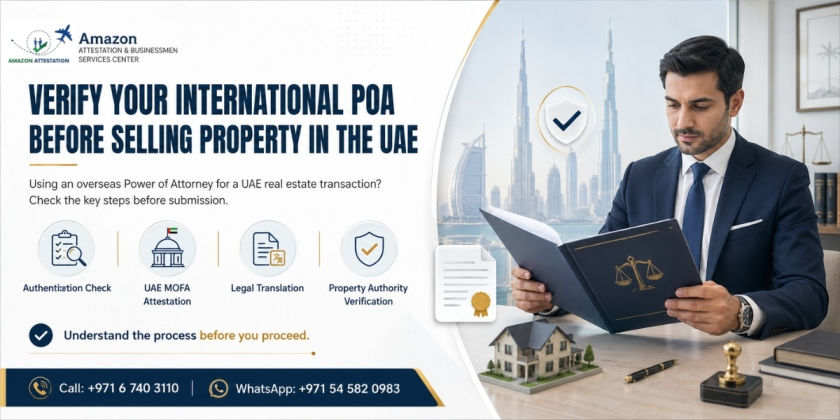
Selling property in the UAE while the owner is outside the country may be possible through a Power of Attorney (POA). However, using a Power of Attorney for UAE Property Sale requires careful verification because the document may need authentication, attestation, translation, and approval checks depending on the property location and receiving authority.
Depending on the country where the POA was issued, the emirate where the property is located, the type of transaction, and the receiving authority, the document may need authentication, legalization or attestation, translation, and additional verification before it can be used.
Understanding these points before starting the process can help reduce delays, repeated document processing, and avoidable rejection.
What Is a Power of Attorney for UAE Property Sale?
A Power of Attorney is a legal document through which one person, known as the principal, authorizes another person to act on their behalf for specified matters.
For a property transaction, the authorized representative may be permitted to carry out certain actions related to the sale or transfer of the property.
Depending on the POA and the receiving authority's requirements, these actions may include:
Representing the property owner
Signing certain transaction documents
Submitting or collecting documents
Communicating with the relevant property authority
Completing specific property transfer procedures
The exact powers granted should be clearly stated.
A POA that is too general, incomplete, or unclear may not be suitable for every real estate transaction.
Why Should an International POA Be Verified Before Use in the UAE?
A POA issued outside the UAE originates from another legal jurisdiction.
Before it is used for an official property transaction in the UAE, the receiving authority may need to determine whether the document is properly executed and whether it meets the requirements for its intended purpose.
Important checks can include:
Whether the document was properly notarized or authenticated
Whether the required legalization or attestation steps have been completed
Whether the names and identification details are consistent
Whether the representative has the necessary authority
Whether the POA clearly covers the intended property transaction
Whether translation is required
Whether the receiving property authority accepts the document in its current form
This is why document attestation alone should not be treated as automatic approval for a property transaction.

How to Verify a Power of Attorney for UAE Property Sale
There is no single procedure that should be assumed to apply to every foreign-issued POA.
The correct route should be determined based on the document's country of origin and the authority that will receive it in the UAE.
1. Check the Purpose and Powers Written in the POA
Before beginning any attestation process, review what the POA actually authorizes.
The document should clearly identify the parties involved and describe the powers being granted.
Depending on the transaction, details may include:
Name of the property owner
Name of the authorized representative
Relevant identification details
Purpose of the authorization
Specific authority related to the property transaction
Property information where required
For real estate transactions, it is especially important not to assume that a general authorization will be accepted for a property sale.
2. Confirm the Authentication Route in the Country of Issue
An international POA may need to undergo authentication or legalization in the country where it was issued.
The required procedure varies by jurisdiction and document type.
Depending on the country, the process may involve one or more of the following:
Notarization
Authentication by a competent government authority
Foreign affairs legalization
UAE Embassy or Consulate legalization or attestation
Because procedures differ between countries, the correct document route should be confirmed before processing begins.
3. Check Whether UAE MOFA Attestation Is Required
After the applicable overseas authentication steps have been completed, the POA may require attestation by the UAE Ministry of Foreign Affairs (MOFA) for official use in the UAE.
MOFA attestation is part of the document authentication process.
However, it is important to understand that a MOFA-attested POA may still be reviewed by the authority handling the real estate transaction.
The authority may check whether the POA wording, scope of authority, supporting documents, and other requirements are suitable for the specific case.
4. Confirm Whether Legal Arabic Translation Is Needed
If the POA is issued in a language other than Arabic, a legal Arabic translation may be required depending on the receiving authority and transaction.
Accurate translation is important because the translated document should reflect the original information correctly, including:
Names
Passport or identification details
Dates
Property information
Powers granted to the representative
Incorrect spelling, missing information, or inconsistent details may lead to additional document checks.
5. Verify the Requirements of the Relevant Property Authority
This is one of the most important steps before using an international POA for a UAE property transaction.
Property procedures are handled by the relevant authorities in each emirate, and requirements may differ according to the property location and transaction.
The receiving authority may have requirements relating to matters such as:
POA wording and scope
Identification documents
Property information
Document format
Attestation or authentication
Translation
Supporting documentation
Validity or acceptance conditions
Therefore, the latest requirements should always be confirmed with the relevant land, real estate, or property authority before relying on the POA.
Common Problems With an International Power of Attorney
Many POA-related delays happen because the document was prepared or processed without first checking its intended use.
The POA Does Not Clearly Authorize the Property Transaction
A document may give general representation powers but may not clearly authorize the representative to perform the specific sale or transfer activity required.
The Authentication Process Is Incomplete
A document may have been notarized but still require additional authentication, legalization, or attestation before it is accepted for official use.
Information Does Not Match
Differences in names, passport details, property information, or translated text can create additional verification requirements.
The Wrong Process Was Followed
Attestation procedures can depend on the country where the POA was issued.
Starting with the wrong process may result in repeat processing and additional delay.
The POA Is Attested but Still Does Not Meet the Receiving Authority's Requirements
Attestation verifies the authentication chain of a document.
It does not necessarily confirm that the document's wording or powers satisfy every requirement of the property authority handling the transaction.
How to Reduce the Risk of Delay or Rejection
Before starting the POA process, it is helpful to confirm four key points:
Where was the POA issued?
This helps determine the correct authentication route.
Where is the property located?
The relevant authority may differ by emirate.
What transaction will the representative perform?
The powers in the POA should match the intended purpose.
What does the receiving authority currently require?
Latest requirements should be confirmed before submission.
Checking these details early can help make the process clearer and reduce unnecessary document reprocessing.
Need Help With International POA Attestation in the UAE?
If you need assistance understanding the document attestation route for an overseas Power of Attorney, Amazon Attestation & Businessmen Services Center can assist with document attestation procedures, UAE MOFA processing support, and legal translation coordination.
Because requirements can vary according to the country of issuance, property location, transaction type, and receiving authority, we recommend checking the document requirements before beginning the attestation process.
Amazon Attestation & Businessmen Services Center
Address: Shop No. 2, Kuwait Building, Sheikh Jaber Al-Sabah Street,
Al Nuaimia 1, Ajman, UAE
Call: +971 6 740 3110
WhatsApp: +971 54 582 0983
Dubai Hotline: +971 4 330 0011
Email: info@amazonattestation.com


Comments